


Phase 10 is an entertaining and strategic card game that tests your capacity for adaptation and planning. In Phase 10 card game, players must complete particular card combinations, or phases, to win. It is played with 2-6 players, and a deck of cards containing numbered cards and special action cards. Now let us know in detail about phase 10 rules where you will be able to know in detail about how many cards in phase 10.
How to play phase 10 – Phase 10 Rules
Objective of the Game:
The main objective of phase 10 is to become the first player to finish all ten phases in a sequential order. There are particular requirements for each phase, such as a combination of sets, colors, or number cards. A player can go on to the following step after finishing the next phase successfully.
If a player does not finish their phase, they have to replay the phase number in a later turn. When playing strategically, a player must carefully manage their cards, taking additional cards when it is favorable, and minimize the number of points they have left at the end of a hand.
Setup:
1. Shuffle the deck: There are 108 cards in this unique deck.
- Regular cards: Regular cards with 1-12 four-color.
- Green cards and Red cards: Green cards and red cards for color schemes.
- Skip cards: Skip cards for skipping an opponent’s turns.
2. Deal cards: Each player receives ten player cards. The top card in the draw pile is made up of the remaining cards. Flip the first card over to start the top of the discard pile.
3. Select a dealer: Randomly choose a dealer. Play proceeds in clockwise direction, with the player on the left of the dealer.
4. Decide on variations: The official rules, a condensed version, or home rules include optional new cards or blank cards to create custom phases that are all available to players.
Player Turn:
The following steps take place during a player’s turn:
1. Draw a card: Either the top card in the draw pile or the top card in the discard pile must be drawn by the player.
2. Play cards:
- Try using a natural card or a combination of cards to finish your own phase.
- Lay down any extra cards for already-existing sets or combinations on the table.
- Partial sets are not counted; only the entire phase may be played.
3. Discard: Place one card from your hand at the top of the discard pile. If the discarded card is a skip card, the next player loses their turn if the discarded card is a skip card.
Key Notes:
- A player is not permitted to play cards from other players’ completed phases, unless permitted by house rules.
- If the player unable to finish their phase, they retain all of their cards for the next hand
- To get the desired card for a phase, strategic decisions must be made in whether to draw from the discard pile against the draw pile.
Completing phases:
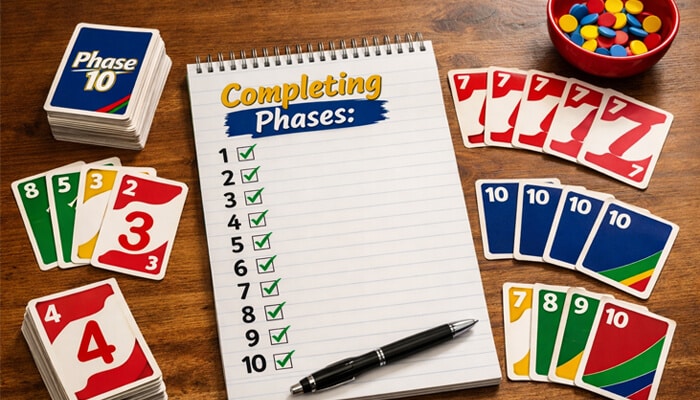
Phases are made up of sets, runs, cards of one color, or a combination of sets and runs. The phase 10 phases are:
- 2 sets of 3
- 1 set of 3 + 1 run of 4
- 1 set of 4 + 1 run of 4
- 1 run of 7
- 1 run of 8
- 1 run of 9
- 2 sets of 4
- 7 cards of 1 color
- 1 set of 5 + 1 set of 2
- 1 set of 5 + 1 set of 3
During each hand, each player can make only one Phase.
Key rules:
- Players must lay down the entire phase at once, partial completion is not allowed.
- A player moves on to the next phase in the following hand after successfully finishing a full phase.
- If they are unable to finish a phase, a player must replay the phase number on their subsequent turn.
End of a hand:
- A hand ends when a player successfully lays down their phase or discards their last card.
- Remaining players score the points based on the total value of the cards left in the hand.
- High-numbered cards are bad when counting toward the total number of points.
- When the hand ends, the player with the fewest total points wins.
- After scoring, a new hand starts and the role of the new dealer rotates clockwise.
Scoring and Winning:
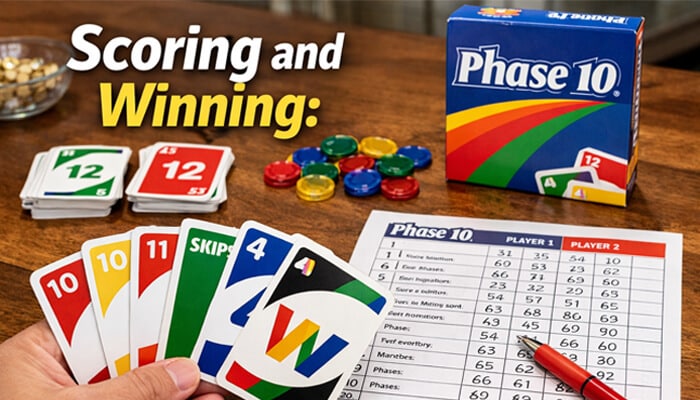
- Track the phases of each player completed as well as the points accumulated from the remaining player cards.
- The game is won by the first player to finish the final phase.
- If there is a tie, the player with the fewest points in the hand or the one who finished their whole phase first wins.
Variations and House Rules:
- Shorter version: Play more quickly by reducing the number of phases.
- Official rules: The full special deck is used in standard gameplay.
- Custom cards: To create distinctive phases, players can utilize new cards or blank cards.
- Additional rules: In certain variants, players can gain strategic advantages by playing additional cards on top of already finished phases.
Regional versions: Phase 10 comes in multiple editions in different countries, including the UK, Australia, and Canada. These editions often include new cards or different color sets to add variation to gameplay.
Strategic Tips:
- You may complete your own phase by taking the intended card at the right moment, so pay attention to the top card of the discard pile.
- Decide when to hold red or green cards for the phases involving combinations of colors.
- Strategically use skip cards to delay opponents on subsequent turns.
- To reduce the value of your hand in the event that someone else finishes their phase first, consider reducing the number of cards that your player possesses.
Conclusion:
I hope this article helps you to know in detail about phase 10 rules and the Phase 10 card game is a race to finish ten unique phases that combine strategy, planning, and luck. It is ideal for casual play or family game nights because of its simple Phase 10 rules, colorful cards, and exciting surprises from wild and skip cards.
Phase 10 is an exciting and thrilling substitute for traditional rummy as a full game takes roughly 60 to 90 minutes, and each round provides a new chance to catch up.
FAQ’s:
Q1. How many cards do you get in phase 10?
Ans. Each player starts with ten cards for every round.
Q2. Can you skip phases in Phase 10?
Ans. No, you must complete each phase until you’ve finished the next.
Q3. What do Phase 10 wild cards mean?
Ans. According to the phase 10 rules, wild cards can represent any color or number required to finish a phase.
Q4. What are skip cards in Phase 10?
Ans. According to the phase 10 rules, skip cards can designate an opponent to forfeit their turn. They can’t be used in phases, they do not count toward sets or runs.
Q5. How many players can play in Phase 10?
Ans. Though Phase 10 is designed for 2 to 6 players, it is best with 3-6 players for more competition.
Q6. How do you win Phase 10?
Ans. Be the first to finish all ten phases. If there is a tie, the person with the lowest score wins.