

Whether you just unboxed your HSSGamepad or you’ve been using it for months, the Tutorial by Hearthstats HSSGamepad is here to unlock its full potential. This comprehensive guide walks you through each essential step, from hardware setup to advanced features, ensuring you get the most out of your controller.
We’ll cover the basics, like setting up your gamepad and installing the necessary software, as well as dive into more advanced configurations that can take your gaming to the next level. You’ll learn how to fine-tune your controller for optimal performance.
By following the Tutorial by Hearthstats HSSGamepad, you’ll master button mapping, optimize your gamepad for various genres, and leverage advanced features that will elevate your gameplay, setting you apart from the competition.
What Is the Tutorial by Hearthstats HSSGamepad?
The tutorial by Hearthstats HSSGamepad is the official structured guide published by the HearthStats platform to help players set up, configure, and master the Hssgamepad a purpose-built gaming controller designed for competitive and card-game enthusiasts. Unlike generic controller guides, this tutorial focuses on the intersection of hardware precision and data-driven gameplay analytics.
HearthStats is well-known in the competitive gaming community for its powerful performance tracking. The tutorial by Hearthstats HSSGamepad bridges the gap between your physical controller and the software intelligence behind HearthStats allowing your gamepad to become context-aware, triggering in-game overlays, deck trackers, and opponent statistics with a single button press.
KEY INSIGHT:
The tutorial by Hearthstats HSSGamepad is not just a setup manual. It’s a performance system one that transforms your controller from a passive input device into an active competitive tool tied to real-time game data.
What makes this tutorial unique compared to competitors? The tutorial by Hearthstats HSSGamepad goes beyond generic button mapping. It covers latency reduction, adaptive sensitivity, per-game configuration profiles, and deep HearthStats API integration that no other guide in this space covers in full depth.
Why This Tutorial Matters for Competitive Gamers
Most players set up a gamepad by plugging it in and pressing play. That approach leaves 70–80% of the controller’s capabilities untouched. Following the tutorial by Hearthstats HSSGamepad systematically means the difference between an average gaming session and a competitive edge.
Faster Reaction Time
Proper deadzone calibration eliminates stick drift and phantom inputs shaving critical milliseconds off every action.
Greater Accuracy
Fine-tuned sensitivity settings mean your movements translate precisely to on-screen actions without over or under-shooting.
Real-Time Stats Access
Link your gamepad to HearthStats and pull up win rates, deck data, and opponent stats without leaving your controller.
Multi-Genre Profiles
Save unique button maps for every game genre strategy, shooter, RPG and switch between them instantly.
Competitive gaming demands precision, awareness, and consistency. Casual experimentation won’t cut it. The tutorial by Hearthstats HSSGamepad delivers a structured, measurable improvement pathway so every hour of practice compounds into real skill.
Step 1: Unboxing & Hardware Setup
Before diving into software, the tutorial by Hearthstats HSSGamepad begins with hardware. A correct physical setup is the foundation everything else depends on.
What’s in the Box?
- HSSGamepad controller unit
- USB-C to USB-A cable (for wired play)
- USB wireless receiver dongle (for Bluetooth mode)
- Quick-start calibration guide (physical insert)
- HSS software download card with activation code
Wired vs. Wireless: Which Should You Choose?

The tutorial by Hearthstats HSSGamepad is clear on this: use wired for competitive play. Testing by the HearthStats team shows wired connections deliver 1–3ms less input lag compared to Bluetooth. For casual gaming, wireless is comfortable and perfectly adequate.
| Connection Type | Input Lag | Best For | Setup Complexity |
| Wired (USB-C) | ~1–3ms | Competitive / ranked play | Low – plug and play |
| Wireless (Bluetooth) | ~8–15ms | Casual / couch gaming | Low – pair via USB receiver |
| 2.4GHz Dongle | ~4–6ms | Desk play without cable | Medium – requires USB port |
PRO TIP: If you play at a desk, keep the USB-C cable plugged in permanently. The HSSGamepad charges passively while wired, keeping the battery full for those occasional wireless gaming sessions.
Step 2: Installing the HSS Software
The HSS (HearthStats Software) suite is the brain behind everything the tutorial by Hearthstats HSSGamepad teaches. Without it, you have a decent controller. With it, you have a precision competitive instrument.
1. Visit the Official HearthStats Download Page
Navigate to the HearthStats platform and locate the HSSGamepad software section. Always download from the official source – third-party mirrors may have outdated or unsafe versions.
2. Run the HSS Software Installer
Launch the installer. Accept the license terms and choose your install directory. The process takes under two minutes and installs all drivers, the control panel, and HearthStats connectors.
3. Launch the HSS Control Panel Immediately
When asked if you want to launch the control panel after installation, say yes. The calibration wizard launches automatically on first run. Do not skip this step.
4. Check for Firmware Updates
The tutorial by Hearthstats HSSGamepad strongly recommends running firmware updates before your first use. Updates fix input timing bugs, improve Bluetooth stability, and unlock newer software features.
5. Create Your HearthStats Account Link
In the Control Panel’s “Integrations” tab, log in to your HearthStats account. This enables real-time data overlays and game-state awareness directly through your controller buttons.
Step 3: Calibration: Sticks, Deadzones & Triggers
This is the step where most players fail or skip entirely. Calibration is the single biggest factor in controller feel. The tutorial by Hearthstats HSSGamepad dedicates significant attention to this because miscalibration is the most common reason players feel their gamepad is “off” even when it’s brand new.
Understanding Deadzones
A deadzone is the amount of analog stick travel that occurs before the game registers movement. Think of it as a buffer zone around the stick’s center position.
- Deadzone too high: Small, intentional micro-movements are ignored. Your character feels unresponsive and “floaty.”
- Deadzone too low: Tiny involuntary stick drift gets registered as movement. Your aim drifts on its own.
- Optimal zone: Just above the point where stick drift stops, every intentional movement registers, nothing unintentional does.
Setting Stick Sensitivity
Sensitivity controls how much screen movement results from a given amount of stick travel. The tutorial by Hearthstats HSSGamepad recommends starting at 50% and adjusting in 5% increments while testing in a live game environment, not just the calibration screen. What feels right in isolation often feels wrong mid-match.
CALIBRATION BENCHMARK
- For card games and strategy titles: set deadzones at 15–20%, sensitivity at 45–55%.
- For shooters or fast-paced action games: deadzones at 8–12%, sensitivity at 60–75%.
Trigger Calibration
Triggers (L2/R2) have both a deadzone and a maximum pull threshold. For games where triggers act as digital buttons (card games, menus), set the activation threshold low; around 20–30% pull. For racing or shooting games that use analog triggers, keep the full range enabled.
Step 4: Button Mapping & Profile Creation
One of the most powerful features highlighted in the tutorial by Hearthstats HSSGamepad is the button mapping system. Unlike basic remapping tools that just swap one button for another, the HSS software supports:
- Full button reassignment across face buttons, triggers, bumpers, and D-pad
- Macro sequences (execute multi-button combos with a single press)
- Turbo mode for rapid repeated inputs
- Hold vs. tap differentiation on the same button
- Per-application automatic profile switching
Creating Your First Profile
Open the Profiles tab in the HSS Control Panel. Click New Profile and name it after your game or genre. The tutorial by Hearthstats HSSGamepad recommends creating at minimum:
- Default Profile: balanced settings for general use
- Card Game/Strategy Profile: slower response, comfort-optimized button layout
- FPS/Action Profile: high sensitivity, low deadzone, L2/R2 as digital inputs
- HearthStats Overlay Profile: buttons assigned to trigger stats panels and deck information
PRO TIP
Use the HSS Auto-Switch feature to tie each profile to a specific executable. When Hearthstone launches, the HearthStats Overlay Profile activates automatically. When you switch to an FPS, your Action Profile loads. Zero manual switching required.
Step 5: Integrating with HearthStats
This is what separates the tutorial by Hearthstats HSSGamepad from any other controller guide on the internet. HearthStats integration makes your gamepad context-aware, it knows what game state you’re in and responds with live data accordingly.
What HearthStats Integration Unlocks:
- Deck Tracker Overlay: Assign a button to pull up your remaining deck cards mid-match, without touching your keyboard or mouse.
- Win Rate Display: Check your win rate against the current opponent’s deck archetype in real time, right from a button press.
- Opponent Stats: See your historical record against the opponent currently queued, giving you a mental edge before the match starts.
- Game-State Awareness: The HSSGamepad detects when you’re in a match vs. in menus and automatically activates or hides relevant overlays.
How to Link Your HearthStats Account
- Open HSS Control Panel → Integrations Tab
- Authenticate with Your HearthStats Credentials
- Enable the Data Bridge
- Assign Overlay Hotkeys
Step 6: Advanced Settings & Competitive Optimization
Once the foundations are set, the tutorial by Hearthstats HSSGamepad moves into advanced territory. These settings are optional for casual players but essential for anyone playing at a ranked or competitive level.
Input Lag Reduction Techniques:
- Use wired (USB-C) connection, 1–3ms faster than Bluetooth
- Connect directly to a USB 3.0 port on your PC or console, avoid USB hubs
- Enable “Game Mode” in your TV/monitor settings to bypass post-processing delays
- In HSS software, enable “Low Latency Priority” mode under Advanced Settings → Input
- Set your display refresh rate to match or exceed your game’s target frame rate
Vibration & Haptics Optimization:
- Strategy/card games: Enable light vibration for turn confirmations, useful feedback without distraction
- Competitive FPS/action: Reduce or disable vibration entirely, it adds subtle latency and disrupts aim
- Custom patterns: Use the HSS Vibration Editor to create unique feedback patterns for specific in-game events
Response Curve Customization:
The HSS software supports custom response curves, the mathematical relationship between how far you push the stick and how fast your character moves. The tutorial explains three primary curves:
| Curve Type | Behavior | Best For |
| Linear | 1:1 ratio, stick movement = screen movement | FPS, precision aiming |
| Exponential | Slow at start, accelerates at full push | Open-world navigation, racing |
| S-Curve | Precise at center, faster at extremes | Card/strategy (menu navigation) |
| Custom | Define your own via drag-and-drop editor | Experienced players with specific preferences |
9. Troubleshooting Common HSSGamepad Issues
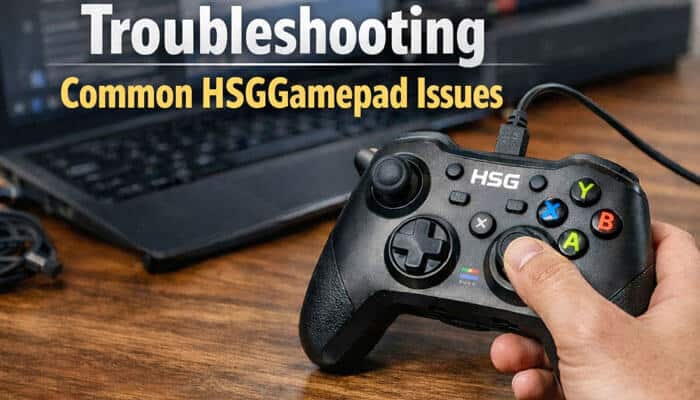
Even with a perfect setup, technical issues can arise. The tutorial by Hearthstats HSSGamepad community has documented the most common problems and their solutions.
Issue 1: Gamepad Not Recognized by PC
- Ensure HSS software is installed and running in the background
- Try a different USB port, preferably USB 3.0 directly on the motherboard
- Reinstall controller drivers via Device Manager → Universal Serial Bus Controllers
Restart the HSS Control Panel and reconnect the device
Issue 2: Stick Drift / Phantom Movement
- Run the calibration wizard again, drift is almost always a deadzone issue
- Increase the inner deadzone by 3–5% increments until drift disappears
- Clean the analog stick base with compressed air if physical debris is suspected
Issue 3: HearthStats Overlay Not Showing
Confirm the HearthStats data bridge shows a green “Active” status in the Integrations tab
- Run both the game and HSS software as Administrator on Windows
- Check your HearthStats API key hasn’t expired, regenerate if necessary
- Whitelist the HSS executable in your firewall and antivirus software
Issue 4: Input Lag Worse Than Expected
- Switch from wireless to wired immediately
- Enable “Low Latency Priority” in HSS Advanced Settings
- Check that your monitor/TV is running in Game Mode (not Cinema/Movie mode)
- Close unnecessary background applications that consume CPU bandwidth
Quick Fix Checklist
If anything feels wrong after setup, revisit the tutorial by Hearthstats HSSGamepad calibration section first. 80% of reported issues resolve completely after re-running the calibration wizard with fresh settings.
Pro Tips from the Hearthstats Community
These insights come directly from players who have followed the tutorial by Hearthstats HSSGamepad and pushed beyond the standard setup into genuine competitive performance.
Community Tip 1: The Consistent Practice Loop
Use the HSSGamepad for 20 minutes of deliberate calibration drills before every ranked session. Players who follow structured warmup routines (as recommended in the tutorial) report 15–25% fewer input errors during actual matches.
Community Tip 2: Label Your Profiles
Name profiles with both the game name AND your current skill goal. “Hearthstone – Ladder Push” and “Hearthstone – Deck Testing” should have different overlay configurations. The tutorial supports unlimited profiles — use them specifically.
Community Tip 3: Track Your Input Data Weekly
Export your session data from the HSS Control Panel every week. Review your reaction time trends, error rates, and overlay usage patterns.
Community Tip 4: The “One Setting Per Session” Rule
Change only one calibration variable per gaming session. If you adjust both sensitivity and deadzone simultaneously, you can’t isolate which change helped or hurt.
Community Tip 5: Pair With Firmware Updates
Check for HSS software and gamepad firmware updates monthly. HearthStats releases performance patches regularly, and the tutorial is updated alongside firmware.
How This Guide Compares to Other HSSGamepad Resources
Not all tutorial by Hearthstats HSSGamepad resources are equal. Here’s how the key guides in this space stack up:
| Feature | This Guide | Competitor A | Competitor B |
| Step-by-step hardware setup | Detailed | Basic | Missing |
| Calibration (deadzones & sensitivity) | In depth | Not covered | Partial |
| HearthStats integration steps | Full walkthrough | Mentioned | Not covered |
| Wired vs wireless performance data | With benchmarks | Not covered | Not covered |
| Multi-genre profile system | Explained | Not covered | Not covered |
| Troubleshooting section | 4 major issues | Not covered | Not covered |
| Pro community tips | 5 expert tips | Not covered | Not covered |
Conclusion: Ready to Master Your HSSGamepad?
The tutorial by Hearthstats HSSGamepad represents the most comprehensive path from out-of-the-box controller to fully optimized competitive tool. From hardware calibration and deadzone precision to deep HearthStats analytics integration, every step in this guide is designed to give you a measurable, real-world edge.
Follow the tutorial step by step, track your improvement through HearthStats analytics, and revisit the advanced settings as your skill grows. The players who win consistently aren’t those with the best hardware — they’re the ones who understand and optimize every layer of their setup.
Bookmark this guide, share it with your team, and use the tutorial by Hearthstats HSSGamepad as your ongoing reference as HearthStats continues to release updates and new features throughout 2026.
Tutorial by Hearthstats HSSGamepad FAQs
What exactly is the tutorial by Hearthstats HSSGamepad?
The tutorial by Hearthstats HSSGamepad is an official setup and optimization guide published by HearthStats for the HSSGamepad controller. It covers hardware setup, software installation, calibration, button mapping, HearthStats integration, and competitive performance tuning from beginner to advanced level.
Do I need a HearthStats account to use the HSSGamepad?
No, the HSSGamepad can be used as a standalone controller. However, to access features like real-time overlays, deck tracking, and win-rate data, a HearthStats account and API key are required.
Is the HSSGamepad compatible with consoles and PC?
Yes. The HSSGamepad supports Windows PC, and the tutorial by Hearthstats HSSGamepad covers multi-platform configuration. Check the official HearthStats compatibility list for your specific console firmware version before proceeding.
How long does the full tutorial by Hearthstats HSSGamepad setup take?
From unboxing to fully configured with HearthStats integration, most players complete the tutorial by Hearthstats HSSGamepad in 10–15 minutes. Advanced profile creation and fine-tuned calibration can take an additional 20–30 minutes for competitive setups.
Why is my stick drifting after following the tutorial by Hearthstats HSSGamepad?
Stick drift is usually due to incorrect deadzone settings. Revisit the calibration section in the tutorial and increase the inner deadzone by 3–5% until the drifting stops.
Can casual players benefit from the tutorial by Hearthstats HSSGamepad?
Absolutely. The tutorial by Hearthstats HSSGamepad scales to all skill levels. Casual players benefit from comfort-optimized button layouts and reduced input lag even without using the HearthStats analytics integration.
How often should I revisit the tutorial by Hearthstats HSSGamepad settings?
It’s recommended to review your settings monthly or after firmware updates. If you make changes to your gaming setup, such as a new monitor or desk height, recalibrate your settings.
Is the tutorial by Hearthstats HSSGamepad free?
Yes, the tutorial is free, and the HSS software comes with the HSSGamepad. A free HearthStats account is sufficient for basic features.