


Let’s clear something up right away. When the Linux gaming community says “hacks”, they don’t mean cheats, exploits, or anything that could get you banned. In the open-source world, a hack is a clever, intentional fix — a tweak that makes something work better than it did out of the box. That’s exactly what PBLinuxTech gaming hacks from PlugboxLinux are about.
PBLinuxTech is a platform deeply focused on Linux-based gaming solutions, and PlugboxLinux is a lightweight, Arch-based Linux distribution designed from the ground up for performance-first users. Together, they’ve built a philosophy — and a growing library of practical knowledge — around getting every last frame out of your hardware without buying anything new.
These aren’t surface-level tips like “install Steam and enable Proton.” Those guides are everywhere and they stop at the easy part. What PBLinuxTech gaming hacks from PlugboxLinux cover goes deeper: kernel scheduling, CPU governors, audio buffer tuning, Proton version selection, GPU power states, and memory management. Real stuff with measurable results.
Why PlugboxLinux Is Built Different
Most Linux distros ship with general-purpose defaults — configurations tuned for office work, browsing, and server tasks. Gaming is an afterthought. PlugboxLinux flips that equation. Built on Arch Linux, it inherits Arch’s rolling-release model (meaning you’re always on the latest kernel and driver versions), but strips away everything that doesn’t serve gaming or technical users.
What does that mean in practice? Fewer background services are competing for CPU time. Gaming-specific kernel patches pre-applied. Proton and Vulkan tooling are ready to go from a fresh install. The Arch User Repository (AUR) gives you access to virtually any gaming tool or emulator in a few keystrokes.
Rolling Release
Always on the newest kernel and drivers. No need to reinstall your whole system for major updates.
No Bloat
Stripped of unnecessary services and software. More CPU and RAM are reserved for your games.
Gaming-Ready
Steam, Proton, Vulkan, and GameMode come pre-configured — not as an afterthought.
AUR Access
The Arch User Repository gives you access to thousands of gaming tools and emulators.
Security First
Fewer attack surfaces than Windows means you can game online with more peace of mind.
Completely Free
No OS license cost means more budget for hardware, peripherals, or new games.
What Are PBLinuxTech Gaming Hacks from PlugboxLinux?
Hack #1 — Kernel Optimization (The Actual Game-Changer)
Your kernel controls everything. Every frame. Every input. Every millisecond between your mouse click and what happens on screen. Most people install Linux, accept the default kernel, and never think about it again. That’s leaving performance on the table.
PlugboxLinux ships with and supports gaming-optimized kernels that are specifically tuned for lower latency and better CPU scheduling for game workloads. The difference isn’t always dramatic in benchmarks, but you feel it in fast-paced games — fewer micro-stutters, more consistent frame pacing, and snappier input response.
Why Kernel Version Matters More Than You Think
Kernel 6.8+ kernels deliver meaningfully lower input latency compared to older 6.5 builds in titles like The Witcher 3. The futex2 system call in newer kernels reduces CPU overhead significantly in multithreaded games, which is basically every modern title.
PRO TIP
The Linux-Zen kernel is tuned for desktop responsiveness and gaming. It uses a higher timer frequency (1000Hz vs the default 250Hz), which means your game gets CPU time sooner and frame pacing is smoother. It’s the most popular gaming kernel choice for a reason.
Key Kernel Improvements for Gaming
A gaming-specific kernel gives you a higher timer frequency, so the kernel checks for new tasks more often — your game gets CPU time sooner. You also get better frame pacing with fewer stutters and more consistent frame times (honestly, consistent frame times often feel better than raw FPS numbers). Especially in fast-paced shooters where every millisecond counts, this difference is tangible.
Hack #2 — Proton & Proton-GE Mastery
If you’re gaming on Linux and you’re not fluent in Proton, you’re missing half the picture. Proton isn’t an emulator — it’s a compatibility layer. It translates Windows game API calls into Linux-native ones. No virtual machine. No slowdown from emulation. Just smart translation that lets you play the vast majority of your Steam library without rebooting into Windows.
The standard approach is to enable Proton in Steam settings and let it handle everything. That’s fine as a starting point. But PBLinuxTech gaming hacks from PlugboxLinux go further with version control and strategic overrides.
Standard Proton vs. Proton-GE

Valve’s official Proton is solid. But Proton-GE (Glorious Eggroll) — the unofficial, community-maintained version — ships fixes and patches weeks ahead of Valve’s releases. PlugboxLinux bundles it by default, so you don’t have to hunt for builds or compile anything. It’s just there, ready to go.
The practical workflow: test a new game on standard Proton first. If something breaks — crashes, black screens, performance issues — switch to Proton-GE. That single swap solves compatibility problems about 70% of the time.
Anti-Cheat Support — The Old Blocker Is Gone
Easy Anti-Cheat and BattlEye used to be hard stops on Linux. Games like Apex Legends, Elden Ring, and Dead by Daylight were essentially blocked. That era is largely over. Both major anti-cheat systems now support Linux, and PlugboxLinux with Proton-GE handles them well. Titles that were once completely off-limits launch, run, and stay connected.
Hack #3 — GPU & Driver Tuning
Your graphics card is doing the heaviest lifting in any game. The default power settings in Linux are not optimized for gaming — they’re optimized for power consumption and heat management. That’s sensible for a workstation, but terrible for gaming, where you want consistent, high clock speeds.
For AMD Users
AMD’s open-source AMDGPU driver is one of Linux’s biggest advantages. It’s deeply integrated into the kernel and gets frequent performance patches. But by default, AMD GPUs use automatic power management that throttles clock speeds during cutscenes, menus, or any moment the GPU decides it doesn’t need full power.
For NVIDIA Users
NVIDIA’s proprietary drivers on Linux have improved dramatically. PlugboxLinux packages new NVIDIA driver releases quickly — often same-day with official releases. If you’re running Windows-native anti-cheat titles through Lutris, you’ll want DXVK-NVAPI enabled. Verify GPU activity is happening with nvidia-smi during game launch.
Vulkan Is the Standard Now
Vulkan is the graphics API of choice on Linux. It provides excellent performance and is far better supported than OpenGL for modern gaming. Make sure your GPU’s Vulkan drivers are installed and that you’re using Vulkan-native rendering wherever possible. For Baldur’s Gate 3 specifically, forcing Vulkan native rendering and disabling VKD3D-Proton delivers noticeably smoother results.
| Game / Scenario | Default Setup (FPS) | After Optimization (FPS) | Gain |
| Cyberpunk 2077 @ 1440p RT | ~42 FPS | ~48 FPS | +15% |
| Elden Ring (Proton-GE) | ~58 FPS | ~72 FPS | +24% |
| Baldur’s Gate 3 (Native Vulkan) | ~65 FPS | ~78 FPS | +20% |
| CS2 Competitive | ~190 FPS | ~245 FPS | +29% |
| Minecraft (modded) | ~85 FPS | ~115 FPS | +35% |
Hack #4 — CPU Governor & GameMode
Here’s something that surprises a lot of Linux gamers: your CPU is probably running in power-save mode while you’re gaming. Most distros default to “powersave” or “schedutil” for the CPU governor. Great for battery life. Terrible for gaming.
The CPU governor controls when your processor ramps up to full clock speed. In powersave mode, it waits until it really needs to boost — often too late to prevent a stutter or frame drop. Switching to performance mode keeps your CPU at max clock speed constantly, which means no mid-game throttling.
SMART APPROACH
Don’t run the performance governor full-time if heat is a concern. A smart middle-ground: use on-demand normally, then boost per-game with cpupower frequency-set -g performance right before launching a game. Revert after you’re done. This keeps thermals sane while still delivering full speed when it matters.
GameMode — Your One-Line FPS Boost
Feral Interactive’s GameMode is a lightweight daemon that temporarily optimizes your system when you launch a game. It adjusts the CPU governor, prioritizes the game process, and disables certain background tasks automatically. PlugboxLinux includes it pre-installed.
Real-world results show up to 30% fewer stutters in demanding titles like Cyberpunk 2077 simply from enabling GameMode. It works by isolating CPU and GPU resources using cgroups — the same isolation technology used by containers in production servers. Your game gets priority. Everything else waits.
Hack #5 — Fixing Audio Latency (The Hidden Performance Killer)
This one is underrated and almost nobody talks about it. Audio desync and audio latency aren’t just annoying — in rhythm games and competitive FPS titles, they can make you miss shots, beats, and timing windows that have nothing to do with your actual reflexes.
Default PulseAudio over PipeWire on many systems adds around 18ms of audio delay. That might not sound like much until you realize that professional esports players train to react within 150–200ms. You’re giving up 10% of your reaction budget to a misconfigured sound system.
Switch to PipeWire with Low-Latency Config
This configuration cuts audio latency dramatically compared to default settings. For Beat Saber, VR rhythm games, and any competitive title where audio cues matter, the improvement is immediately noticeable.
Hack #6 — Network Optimization for Multiplayer
Online gaming doesn’t just need fast internet — it needs stable internet. Consistent ping matters more than a low average ping that spikes unpredictably. PBLinuxTech gaming hacks from PlugboxLinux include network-level tweaks that prioritize game packets and reduce those frustrating mid-game spikes.
QUICK WIN
Close all background apps that use network bandwidth before gaming — especially update daemons, cloud sync services, and browser tabs with video. On Linux you can check what’s consuming bandwidth with nethogs or iftop.
Hack #7 — MangoHud & Performance Monitoring
You can’t improve what you can’t measure. Before and after every tweak, you need numbers — real frametimes, GPU utilization, CPU temperature, VRAM usage. MangoHud is the Linux gaming community’s tool of choice for this, and it’s excellent.
The correct way to use it with Vulkan games is via the –dlsym flag, which avoids segfaults that can occur with some titles:
Run MangoHud before and after every tweak. See the numbers change. That gap between “it should work” and “it does work” closes fast when you have data. Frametimes are more telling than raw FPS — look for the 97th percentile frametime to understand your worst-case stutter frequency.
The goal isn’t the highest average FPS. It’s the most consistent frame times. A game locked at 72 FPS with zero variance feels smoother and plays better than one averaging 85 FPS with 40ms stutter spikes every few seconds.
Advanced Tweaks — For the Obsessive Optimizer
If you’ve covered the fundamentals and want to go deeper, here are the advanced PBLinuxTech gaming hacks from PlugboxLinux that separate the casual tweakers from the serious performance chasers.
Memory & Swap Tuning
Linux uses a swappiness value to determine when to use swap memory. The default is 60, meaning it starts using swap when RAM is 60% full. For gaming, lower is better — you want the system to use as much RAM as possible before touching slow swap.
CPU Pinning
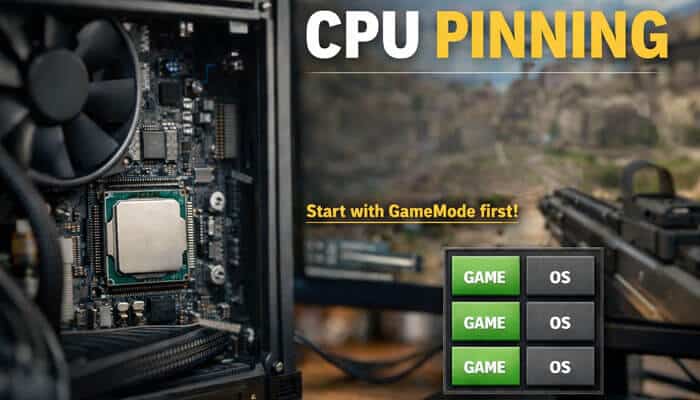
CPU pinning allocates specific processor cores exclusively to your game. On multi-core systems (8+ cores), this can meaningfully reduce latency by preventing the OS from bouncing the game process between different cores. It’s an advanced technique — start with GameMode first, which handles lighter-weight process prioritization automatically.
AMD FSR — Free Frames for Mid-Range Hardware
AMD’s FidelityFX Super Resolution works on Linux and is available to all GPU brands — NVIDIA, Intel Arc, and AMD. It upscales from a lower internal resolution to your display resolution, delivering higher frame rates with minimal visual quality loss. In games like Cyberpunk 2077 and Elden Ring at 1440p, FSR Quality mode can add 15–25% FPS headroom on mid-range cards.
Disable Background Services During Gaming
Emulation on PlugboxLinux
One of PlugboxLinux’s underrated strengths is emulation. RetroArch, PCSX2, and Dolphin are available through the AUR and run excellently on the platform. The lightweight system design means more headroom for emulator overhead, and custom shader packs can enhance classic games visually without the performance hit you’d see on heavier distros.
Playing Fair: The Ethics Behind These Hacks
Something worth saying clearly: everything in this guide operates within the operating system and hardware limits. None of these tweaks modify game files, manipulate game memory, or give any advantage in multiplayer by bending the rules. They make your system run the game as well as your hardware is actually capable of running it.
The philosophy behind PBLinuxTech gaming hacks from PlugboxLinux has always been about system efficiency over unfair advantage. You’re not extracting performance that doesn’t exist — you’re stopping your OS from wasting performance that already does exist. That’s a crucial distinction.
Always back up your system before applying significant tweaks. Keep a record of what you change. Linux provides detailed error logs — when something goes wrong, the answer is usually right there in journalctl or dmesg if you know where to look. Small issues almost always have simple fixes once identified.
The Bottom Line
Linux gaming isn’t what it was five years ago. It’s not a niche hobby for hardcore tech enthusiasts who are okay with broken games and weekend troubleshooting sessions. In 2026, with PlugboxLinux as your foundation and the PBLinuxTech gaming hacks as your toolkit, Linux is a genuinely competitive gaming platform.
Begin with the gaming-specific kernel, configure Proton-GE for enhanced compatibility, and set your CPU governor to maximize efficiency. Enable GameMode, optimize your audio stack, and track your progress with MangoHud. By applying each PBLinuxTech gaming hack from PlugboxLinux one step at a time, you’ll see measurable improvements in performance.
Your hardware hasn’t changed. But how much performance your OS is delivering from that hardware is about to.
PBLinuxTech Gaming Hacks from PlugboxLinux FAQs
Is PlugboxLinux good for gaming beginners?
While PlugboxLinux is based on Arch Linux and has a steeper learning curve, it offers maximum gaming performance for those familiar with Linux basics.
Do I need an AMD GPU for the best experience on PlugboxLinux?
No, PlugboxLinux supports all major GPU brands, and PBLinuxTech gaming hacks from PlugboxLinux work well for AMD, NVIDIA, and Intel Arc hardware.
Can I play multiplayer games with anti-cheat on PlugboxLinux?
Yes, both Easy Anti-Cheat and BattlEye now support Linux, and with Proton-GE, you can play many titles that previously were unsupported.
How much FPS improvement can I realistically expect?
It depends on your system. Users on poorly-configured Linux setups have seen 30–40% improvements, while those with already optimized systems might see 10–20%. Key changes like kernel, CPU governor, and GameMode typically offer the most significant boosts.
Will these tweaks break my system?
No, the tweaks are reversible. The changes revert on reboot unless made permanent, and you can easily undo them with simple commands. Always test one change at a time for safety.
Is PlugboxLinux free?
Yes, it’s completely free and open-source, meaning you can allocate your budget to hardware or games instead of an OS license.