


Canasta is a card game that is very popular today among both youngsters and adults. So, if you want to learn about this entertaining card game, you’ve come to the right place. The most useful canasta techniques include strategic pile control, cautious wild card management, and careful meld building. Successful players concentrate on timing their first melds precisely when thinking about how to play canasta. After that, they master partnership communication in four-player games. They also finish natural canastas whenever possible.
The ideas in this blog are always useful whether you’re playing hand-and-foot, conventional canasta, or easy online variations.
From beginning basics to sophisticated methods, here are some crucial strategies arranged by ability level that will improve your canasta game across every variation and player count. Read this blog to gain a deeper understanding.
Strategies That Teach How To Play Canasta for Beginners
Starting Right
When learning how to play canasta, it is essential to have a solid understanding of the rules. For your first play, concentrate on understanding the minimum meld requirements: teams with negative scores only need 15 points to meld at first.
Whereas teams with greater scores need 50, 90, or 120 points, respectively.
In general, natural canastas, that don’t contain any wild cards score more points than mixed ones. Users should practice distinguishing between the two types. Focusing on which one to pursue will be possible by knowing all the differences.
Team Up with Experienced Players
Finding out how to play canasta with more expert players speeds up anyone’s process of learning. They will guide your starting steps and explain strategic choices if the games progress.
Notice the discard moves made by powerful players. Take note of how such players build up their subsequent plays without offering sound cards to other players. To gain good feedback, ask clever questions about diverse scenarios.
Play Safe
Beginners benefit much from conservative play. This is because their strategic vision strengthens when figuring out to play canasta card game. Focus on the game’s core elements instead of intricate strategic analysis.
If you can’t use several cards at once, don’t pick the present discard pile. Start by capturing smaller but easily manageable stacks. Do it until your hand organization gets better. Put finishing canastas ahead of starting several unfinished melds.
Intermediate Canasta Strategies for All Players
Mastering the Initial Meld
When and how vigorously to pursue early scoring possibilities depends on precisely calculating your initial meld demand.
It takes 90 points for teams with scores between 1,500 and 2,995 to merge at first, and it takes 120 points for teams in the canasta card game with scores exceeding 3,000.
Instead of depending only on single high-value combos, plan your first meld by counting possible points over several cards. If your hand has weak follow-up potential, think about holding back.
Discard Pile Tactics

If you wonder how do you play canasta, know that both offensive and defensive factors are involved in strategic discard pile management. Avoid discarding cards that finish opponents’ visible melds or typical canasta combinations (sevens, eights, nines) when playing defense.
Offensively, keep an eye on the makeup of the discard pile to determine the best time to make captures. Smaller stacks should usually be avoided, but large piles containing several sound cards justify taking chances.
Wild Card Management
Instead of employing wild cards early in the meld construction process, save them for finishing canastas and learn the canasta card game rules. As games advance, wild cards gain value, and using them too soon frequently results in strategic dead ends.
If you can, keep the ratio at 2:1. In mixed canasta, this means utilizing two natural cards for each wild card. To determine how many are still in play, count the visible wild cards of your opponents.
Advanced Canasta Strategy: 7 Ways To Win
Optimal Card Management
In powerful hand organization, cards are put together not just by rank but also by permissible meld combinations. Keep mental categories for multipurpose cards and possible future melds. They also help immediate melds.
Learn how to count cards when thinking how to play canasta. Do this so you can notice the cards that have been played. Now, find which combinations are not possible at all.
Partner Play: Communication Is the Key
In four-player canasta, strategic moves and silent signals helps so much. Your partner can learn about your hand composition from your discard decisions. They will also use meld timing and pile-taking moves.
Boost team scoring but reduce opponents’ opportunities. Talk with your partner to help for meld completion timing.
Wait for the Ideal Time to Make a Move
You shouldn’t act just because you can and think of doing it. Skilled players find out that timing in a lot of times is more important than the actual action. This is true especially when completing canastas or picking the present discard pile.
Before making important moves, assess the entire game state. Ask yourself these questions: Do you lead or lag behind? How many cards are still available? What details will your opponents learn from your move?
Be Aware of the Discard Pile
Continually try to find the composition of the discard pile, not simply while thinking about captures. Compare the risks and rewards of pile capture. This is posible if you think about both immediate utility and the impact of capture on hand balance.
Going Out at the Right Time
When timing your leave, you must strike a balance between maximizing your score and limiting your opponent’s remaining options. Waiting too long puts opponents at risk of finishing important canastas, while leaving the table too early results in points being lost.
Special Canasta Tips and Tricks
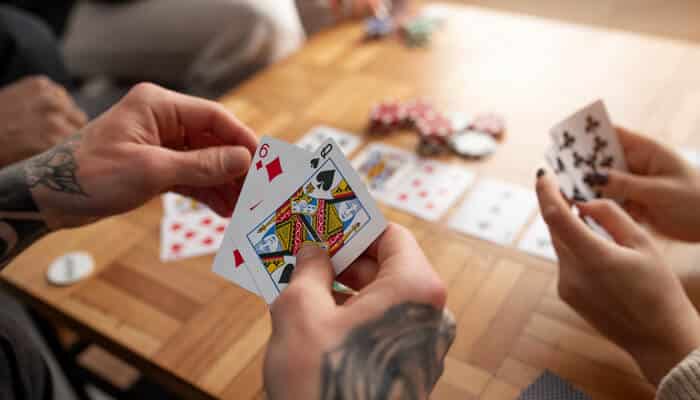
Canasta Strategy for Four Players
In four-player games with standard canasta rules, collaboration is essential. Use clever discarding to communicate; don’t assist opponents while assisting your partner’s melds.
To maximize scoring possibilities and prevent competition for the same cards, divide meld responsibilities among partners.
2-Player Canasta Strategy
Individual hand management is prioritized above cooperative play in two-player games. Since you can’t depend on a partner, concentrate a lot on defensive discarding. As you only keep track of one opponent’s moves, card counting becomes increasingly crucial.
Double Deck Canasta Strategy
Give natural canastas priority over mixed ones when there are more cards available. For lengthier, higher-scoring games, modify your approach and account for several canastas per player.
Hand and Foot Canasta Strategy
To reach your foot, which frequently has better cards, finish your hand swiftly. Make sure to thoroughly plan your transition and work with your partner during both stages.
Final Thoughts
So, that’s all you need to know about how to play canasta and the rules of it. You can find many online platforms that provide accurate scoring information and automatic deals for playing canasta.
Make better strategic judgments by utilizing digital tools, and adjust your schedule to fit online interfaces. Utilize a variety of opponents to hasten your strategic advancement.