


In today’s data-driven and highly standardized environments, accurate identification systems play a critical role in maintaining consistency, traceability, and operational efficiency. From manufacturing and supply chain management to IT infrastructure and asset tracking, model numbers provide a reliable way to classify, verify, and manage products and components.
The model xucvihkds number is one such identifier gaining attention for its structured format and practical application across multiple technical and commercial contexts. This guide explains what it is, how it works, why it matters, and how professionals can use it effectively in real-world scenarios.
Whether you are a procurement specialist, technician, engineer, or business owner, understanding the model xucvihkds number can help reduce errors, streamline operations, and improve decision-making.
What Is a Model Xucvihkds Number?
A model xucvihkds number is a structured alphanumeric identifier assigned to a specific product, component, or configuration. Its primary purpose is to:
- Distinguish one model from another
- Encode key specifications
- Enable fast and accurate referencing
Unlike generic serial numbers that only indicate sequence, this model number often carries embedded meaning related to product type, version, features, and manufacturing details.
In many systems, it aligns with principles established by standards bodies such as International Organization for Standardization, which promote consistency and interoperability across industries.
Why the Model Xucvihkds Number Matters
Organizations rely on precise identification to avoid costly mistakes and inefficiencies. The model xucvihkds number supports this goal in several important ways.
1. Accurate Product Identification
A single character difference in a model number can represent a different configuration, capacity, or compatibility profile. Using the correct model xucvihkds number ensures you are referencing the exact product required.
2. Simplified Procurement
Purchasing teams can:
- Verify compatibility before ordering
- Avoid duplicate or incorrect parts
- Speed up vendor communication
3. Improved Maintenance and Support
Service technicians can quickly determine:
- Correct replacement parts
- Firmware or software compatibility
- Applicable service manuals
4. Enhanced Traceability
Model numbers support tracking across:
- Manufacturing
- Warehousing
- Distribution
- End-user deployment
Typical Structure of a Model Xucvihkds Number
While formats vary by manufacturer or system, most model xucvihkds numbers follow a logical pattern.
Example format (illustrative):
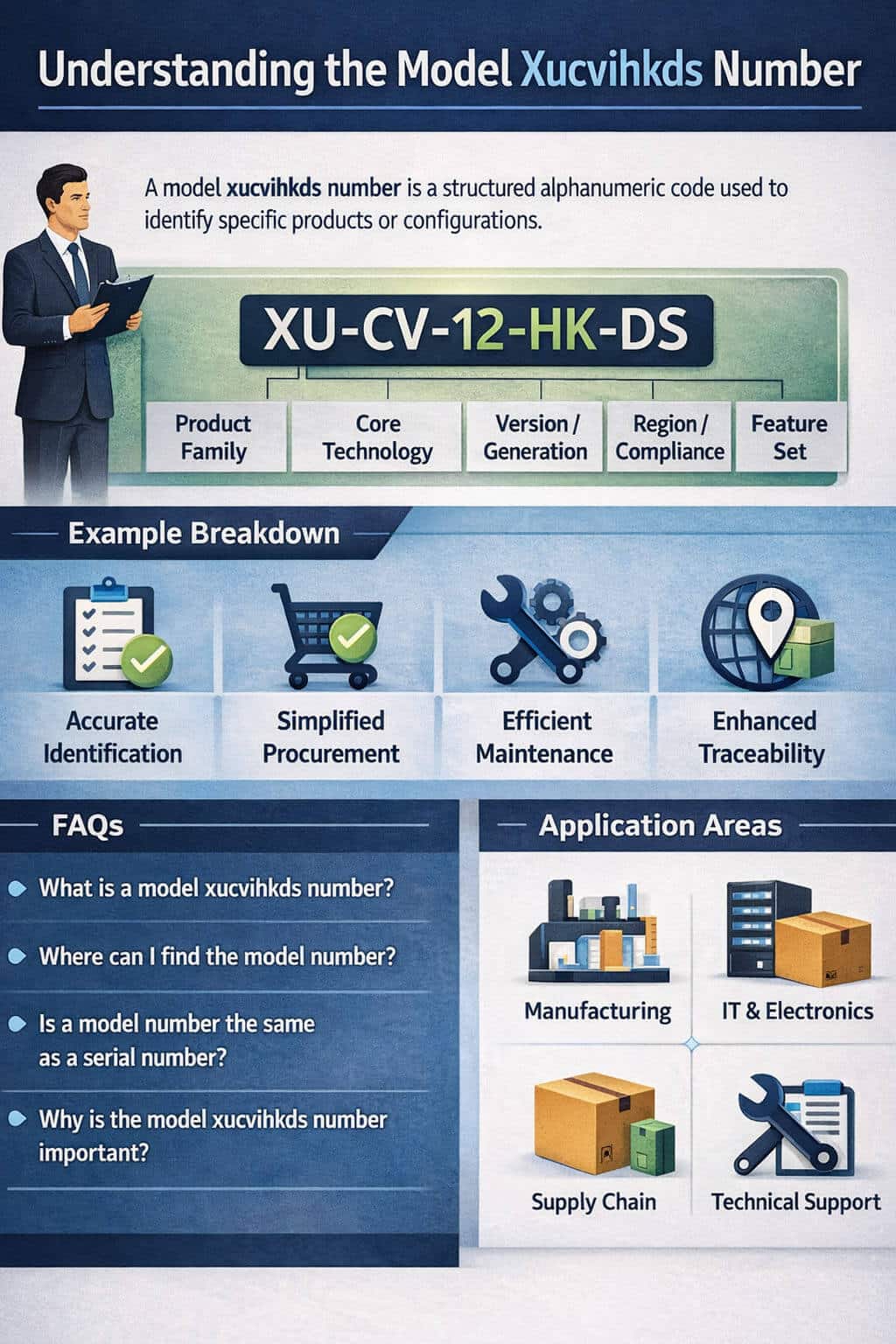
XU-CV-12-HK-DS
Common Segments Explained
- XU – Product family or category
- CV – Core technology or platform
- 12 – Version, generation, or capacity
- HK – Region or compliance variant
- DS – Feature set or configuration type
Each segment conveys specific information that helps professionals interpret the model quickly.
How to Read and Interpret a Model Xucvihkds Number
Understanding the structure allows users to extract meaningful insights without needing a full specification sheet.
Step 1: Identify the Product Family
The opening characters usually define the broader category.
Step 2: Decode the Platform or Technology
This reveals the underlying system or design architecture.
Step 3: Check Version or Generation
Higher numbers often indicate newer revisions or enhanced capabilities.
Step 4: Confirm Regional or Compliance Codes
Some models differ based on regulatory or operational requirements.
Step 5: Review Feature Indicators
The final segment often specifies optional features or bundled capabilities.
Where Model Xucvihkds Numbers Are Commonly Used
The model xucvihkds number concept applies across multiple sectors.
Manufacturing
- Component classification
- Assembly verification
- Quality control documentation
Information Technology
- Hardware configuration management
- Asset inventories
- Support ticketing
Electronics and Devices
- Product differentiation
- Firmware matching
- Warranty validation
Logistics and Supply Chain
- SKU mapping
- Inventory tracking
- Shipping documentation
Benefits of Using Model Xucvihkds Numbers Correctly
Proper usage delivers measurable operational advantages.
- Fewer ordering errors
- Faster troubleshooting
- Reduced downtime
- Improved inventory accuracy
- Stronger supplier communication
Over time, these benefits translate into cost savings and higher reliability.
Model Xucvihkds Number vs. Serial Number
Although often confused, these identifiers serve different purposes.
| Aspect | Model Xucvihkds Number | Serial Number |
| Purpose | Identifies product type and configuration | Identifies individual unit |
| Format | Structured, meaningful | Usually sequential |
| Changes between units | No | Yes |
| Used for | Compatibility, classification | Warranty, tracking |
Both are important, but they answer different questions.
Best Practices for Managing Model Xucvihkds Numbers
Organizations should treat model numbers as critical data points.
Centralize Documentation
Maintain a master database with:
- Full model numbers
- Descriptions
- Specifications
Use Standard Naming Conventions
Avoid internal variations that create confusion.
Validate During Data Entry
Implement checks in ERP or inventory systems.
Train Staff
Ensure teams understand how to read and use model numbers.
Common Mistakes to Avoid
- Copying model numbers manually without verification
- Assuming similar-looking models are interchangeable
- Ignoring suffixes or regional codes
- Using internal nicknames instead of official identifiers
Small mistakes can lead to large operational consequences.
How to Find a Model Xucvihkds Number
Depending on the product, it may appear:
- On product labels or nameplates
- In user manuals
- On packaging
- Inside software system information screens
- On purchase invoices
If unavailable, contacting the manufacturer or supplier with product details usually resolves the issue.
Using Model Xucvihkds Numbers in Digital Systems
Modern platforms rely heavily on structured identifiers.
ERP Systems
Link model numbers to BOMs, vendors, and pricing.
Asset Management Tools
Track deployments and lifecycles.
E-Commerce Platforms
Ensure accurate product listings and compatibility filters.
Support Portals
Route issues to correct documentation and expertise.
Security and Data Integrity Considerations
Model numbers should be protected as part of operational data.
- Limit editing permissions
- Track change history
- Back up databases regularly
While model numbers themselves are not sensitive, incorrect or manipulated data can disrupt operations.
Frequently Asked Questions
What is a model xucvihkds number?
It is a structured alphanumeric identifier used to classify a specific product model, including its family, version, and configuration.
Where can I find the model xucvihkds number on a product?
It is typically printed on a label, included in documentation, or displayed in system information menus.
Is a model xucvihkds number the same as a serial number?
No. The model number identifies the product type, while the serial number identifies an individual unit.
Why is the model xucvihkds number important?
It ensures correct ordering, compatibility, support, and documentation.
Can two products share the same model xucvihkds number?
Yes, if they are the same model and configuration. Their serial numbers will differ.
Global Usability Considerations
Model numbering systems are designed to be language-neutral and globally consistent. When used correctly, they:
- Support international procurement
- Enable cross-border servicing
- Reduce translation dependency
This makes the model xucvihkds number suitable for global operations and multicultural teams.
Future of Model Numbering Systems
As digital transformation advances, model numbers will increasingly integrate with:
- QR codes and RFID
- Digital twins
- Cloud-based asset platforms
However, the core concept of a structured, human-readable model identifier will remain essential.
Conclusion
The model xucvihkds number is more than a simple code. It is a foundational element of modern product identification, enabling accuracy, efficiency, and scalability across industries. When understood and managed correctly, it reduces risk, saves time, and improves operational clarity.
For organizations seeking better control over products, assets, and documentation, implementing strong model number practices is a practical and high-impact step. If you need guidance on organizing or standardizing your model identification systems, consult an experienced technical documentation or data management specialist for tailored support.